Example - Force on a Magnetized Sphere
This example showcases:
- Computing magnetic fields using a current-carrying finite element mesh as the source
- Determining magnetization (\(M\)) field of a 3D object with linear magnetic material properties
- Calculating the force acting on the magnetic body due to the fields generated by the current-carrying mesh
Problem Parameters
A loop magnet:
- Radius \(R = 1.0 m\), centered at the origin
- Square cross-section \(h = 0.1 m\)
- Total current of \(I = 10e6 A\) (amp-turns)
(Wow, that's a lot of current! Keeps fields in nice whole numbers...)
A magnetic sphere:
- Diameter of \(d = 0.1 m\)
- Centered on the z-axis, with height \(z = 0.2 m\)
- Relative permeability of \(\mu_r = 1.5\) (mildly magnetic)
Geometry and Mesh
Load the geometry from step files:
import oersted
import numpy as np

loop_mesh_size: float = 50e-3 # (m)
loop_mesh = oersted.Mesh.from_step("loop_magnet.stp", loop_mesh_size)

sphere_mesh_size: float = 15e-3 # (m)
sphere_mesh = oersted.Mesh.from_step("sphere.stp", sphere_mesh_size)
sphere_mesh.nodes[:,2] += 0.2 # (m), move up from (0, 0, 0)
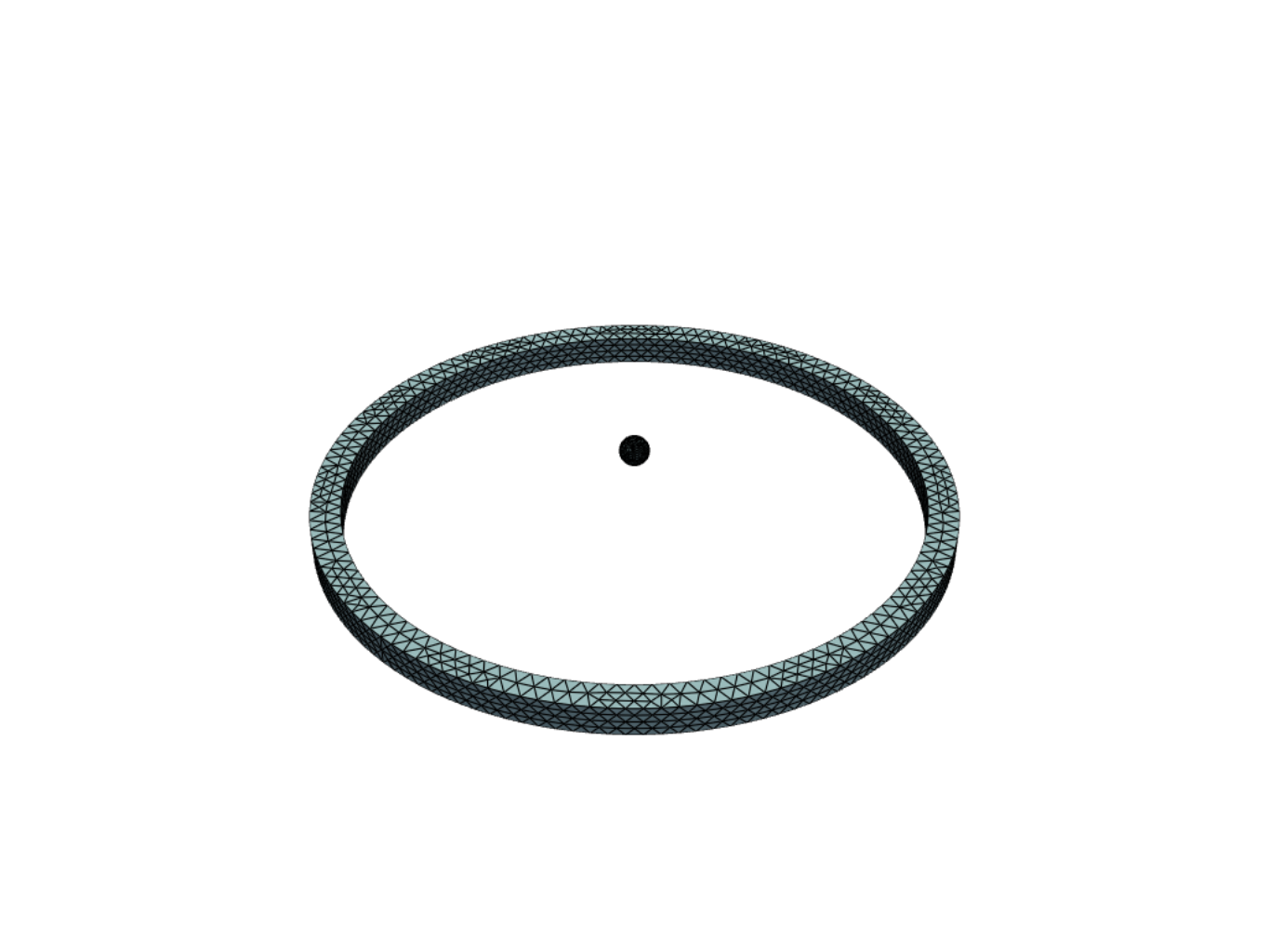
Visualize the meshes together:
# This creates a new mesh, which is not used later
loop_mesh.append(sphere_mesh).plot("meshes.svg")
Loads
The loop has a current flowing through it, which means we need to calculate the
associated current density. This is simply an (Ne, 3) array of vectors, where Ne
is the number of elements in the loop magnet mesh:
area: float = 0.01  # (m^2)
j_density: NDArray[float64] = np.zeros(loop_mesh.centroids.shape)
jmag: float = current / area
phi: NDArray[float64] = np.atan2(
    loop_mesh.centroids[:, 1],
    loop_mesh.centroids[:, 0]
)
j_density[:, 0] = -jmag * np.sin(phi)
j_density[:, 1] = jmag * np.cos(phi)
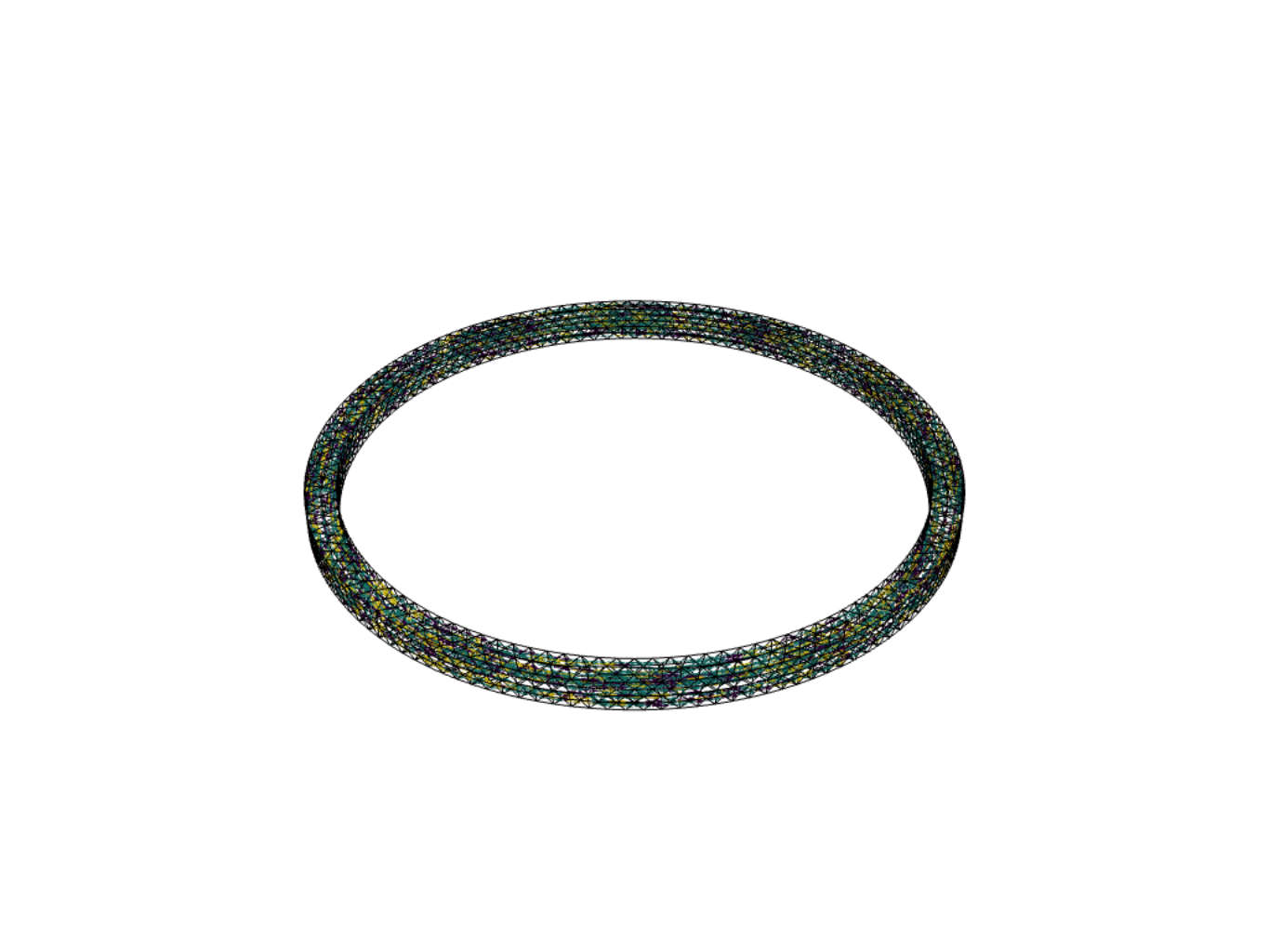
To visualize:
oersted.plot_mesh(
    loop_mesh,
    centroids = loop_mesh.centroids,
    vectors=j_density,
    vector_scale = 5.0e-2,
    transparency=True
)
(admittedly a bit difficult to see with this particular form factor)
Fields Calculations
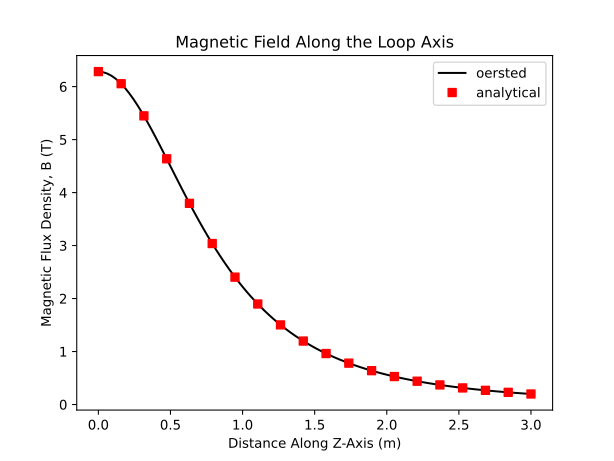
The magnetic field generated by a current-carrying loop has a well-understood analytical expression (see Ref 4), particularly at the centerline of the loop: $$ B_z(z) = \frac{\mu_0 \cdot I \cdot r^2}{2 \space (z^2 + r^2)^{1.5}} $$
We can compute the magnetic field along the axis using the loop magnet's mesh, and compare it against the analytical solution:
n_pts: int = 100
axis_pts = np.zeros((n_pts, 3))
axis_pts[:,2] = np.linspace(0.0, 3.0, n_pts)
bz_axis = oersted.b_field(loop_mesh, j_density, axis_pts, solver=solver)
 .
.
Now to calculate the background magnetic fields generated by the loop, acting on the sphere, as well as the magnetization of the sphere:
# Compute the external field acting on the sphere
bext = oersted.b_field(loop_mesh, j_density, mesh.centroids, solver=solver)

# Solve for the magnetization of the sphere and demagnetization field
M, H = oersted.demag_solve(mesh, material, bext / oersted.MU0, solver)
Force Calculation
Now that we've determined the fields within the sphere, we can solve for the force
acting on it. To check the result from oersted, use an analytical approximation:
- The internal magnetization field is aligned with the background field
- The sphere acts like a perfect dipole, with associate magnetic moment $\vec{m}=\vec{M}\cdot V $
- Since the sphere is symmetric on the z-axis of the loop, we assume the forces acting on it in the x- and y-directions are perfectly balanced, so there's only net force in the z-direction.
- The net force in the z-direction is pulling it towards the plane of the loop (downwards)
We use the expression for Kelvin force:
$$ F = (m\cdot\nabla)B $$
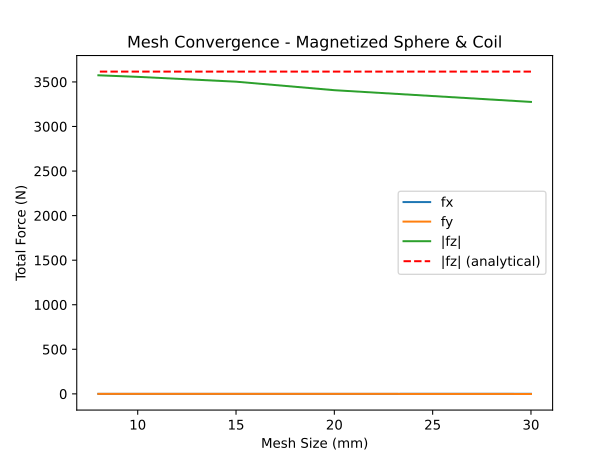
The background magnetic field at \(z = 0.2 m\) is \(B_z = 5.924 T\). The magnetization of a sphere in a uniform background field has an analytical solution; for this demo we'll assume that the field is uniform:
Differentiating the analytical expression for the field gradient at z=0.2m:
$$ \partial B_z / \partial z = -3.418 T/m $$
Therefore, we expect approximatately:
$$ F = m \cdot \partial B_z / \partial z = -3616 N $$
Computing this value in oersted requires a handful of steps:
# Compute the background field on the nodes for the Kelvin force evaluation
b_field_nodes = oersted.b_field(loop_mesh, j_density, mesh.nodes, solver=solver)

# Use the magnetization at the centroids and the B-field at the nodes to compute
# the Kelvin forces acting on the centroids
forces = oersted.kelvin_forces(mesh, M, b_field_nodes)

total_force = np.sum(forces, axis=0)