Example - Two Magnetized Spheres
This example showcases:
- Applying magnetic fields directly to simulate theoretical conditions
- Using the magnetization solver to compute the response of a linear material to an external field
- Computing forces between magnetized objects and matching them to an analytical solution
Problem Statement
Two spheres are suspended in a $ 5 T $ background field
- Each has radius $ R = 100mm $
- The spheres are separated by a distance of $ d = 300 mm $
- The sphere material has a relative permeability of $ \mu_r = 2.5 $
Mesh the Spheres
Load the geometry from STEP files:
import oersted, numpy as np
from oersted import Mesh, MU0

mesh_size: float = 10.0e-3 # (m)
distance: float = 0.3 # (m)
upper_sphere = Mesh.from_step("sphere.stp", mesh_size)
upper_sphere.nodes[:,2] += distance/2.0
lower_sphere = Mesh.from_step("sphere.stp", mesh_size)
lower_sphere.nodes[:,2] -= distance/2.0

combined_mesh = upper_sphere.append(lower_sphere)
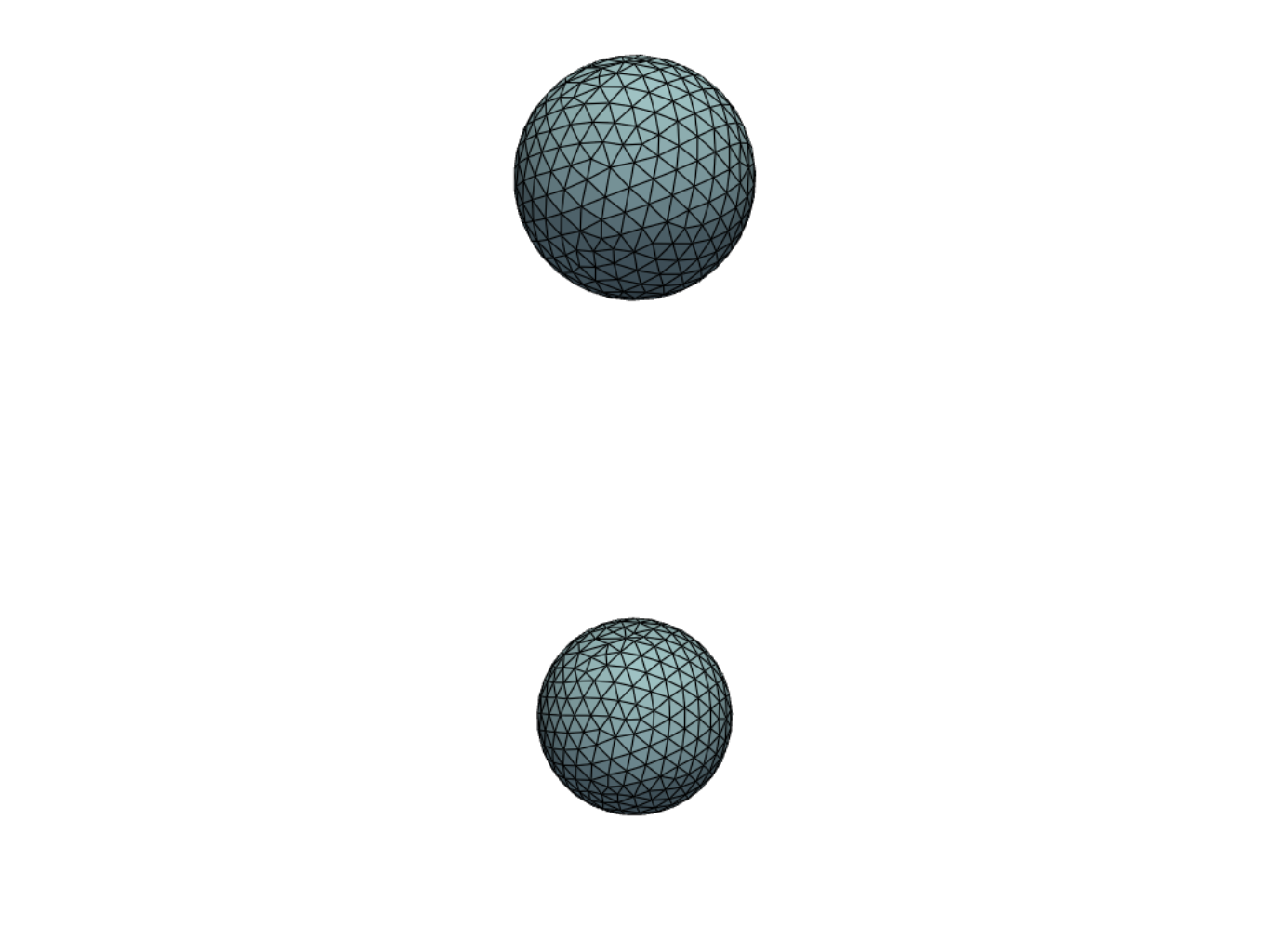
combined_mesh.plot()
Background Field
Apply a constant background field to both of the spheres:
b_background: float = 5 # (T)

# We differentiate between 'background' and 'external' field
# Within the spheres, there will be multiple sources of H field
h_external: float = np.zeros(combined_mesh.centroids.shape)
h_external[:,2] = b_background / MU0
Solve
Assign a material, select solution options, and solve the problem:
mu_r: float = 2.5
material = oersted.LinearMaterial(mu_r)

# Tolerance is on H-field, not B-field, so this is actually something
# like 1e-6 T
# The relaxation factor helps with convergence and is necessary for mu_r > 2.0
solver = oersted.DirectSolver(tol=1e0, alpha=0.5)

# We solve for the magnetization and the total internal H field in the spheres,
# but we only need the magnetization
# B = mu0 * (M + H)
M, _ = oersted.demag_solve(combined_mesh, material, h_external, solver)
Compute the Interaction Forces Acting Betwee the Spheres
This problem has an analytical solution we can use to approximate the problem as an interaction between two perfect dipoles:
(equal and opposite between the two spheres)
# Select only the magnetization field in the appropriate sphere
M_lower = M[: lower_sphere.num_elems]
M_upper = M[lower_sphere.num_elems :]

# Compute the total field acting on the nodes of both spheres,
# using only the other sphere as a source
h_field_nodes_upper = oersted.h_mag(
    lower_sphere, M_lower, upper_sphere.nodes, solver=solver
)
h_field_nodes_lower = oersted.h_mag(
    upper_sphere, M_upper, lower_sphere.nodes, solver=solver
)
h_field_nodes_upper[:, 2] += b_external_magnitude / MU0
h_field_nodes_lower[:, 2] += b_external_magnitude / MU0

# Compute the forces acting on each sphere
forces_upper = oersted.kelvin_forces(upper_sphere, M_upper, MU0 * h_field_nodes_upper)
forces_lower = oersted.kelvin_forces(lower_sphere, M_lower, MU0 * h_field_nodes_lower)

# Sum the forces and output
force_upper = np.sum(forces_upper, axis=0)
force_lower = np.sum(forces_lower, axis=0)
Which produces an output like this:
Force on upper sphere:         ( 0.0, 0.0,-314.7) N
Force on lower sphere:         (-0.3,-0.1, 314.7) N
Fields
We can plot the fields along an axis intersecting both spheres, to show how the magnetization primarily acts on the surface:
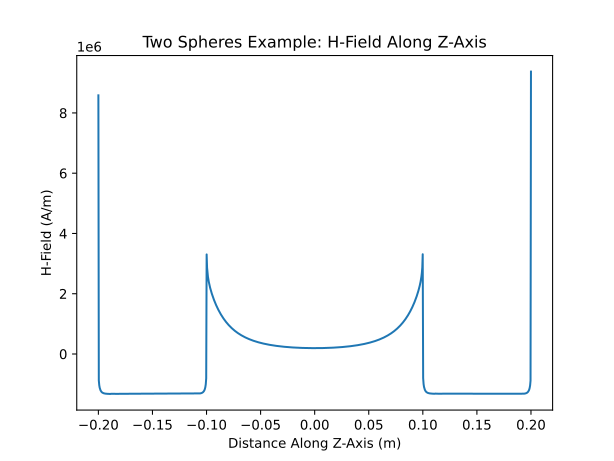
The upper sphere spans the space from z = [0.1,0.2] m, and the lower sphere spans the space from z = [-0.1, -0.2] m. Due to the very sharp increase in field at the surfaces and the curvature of the geometry, the solver has trouble computing a truly symmetric field.